Best Sim Racing Pedals
By PitLaneLab · 8 min read · Updated July 2026
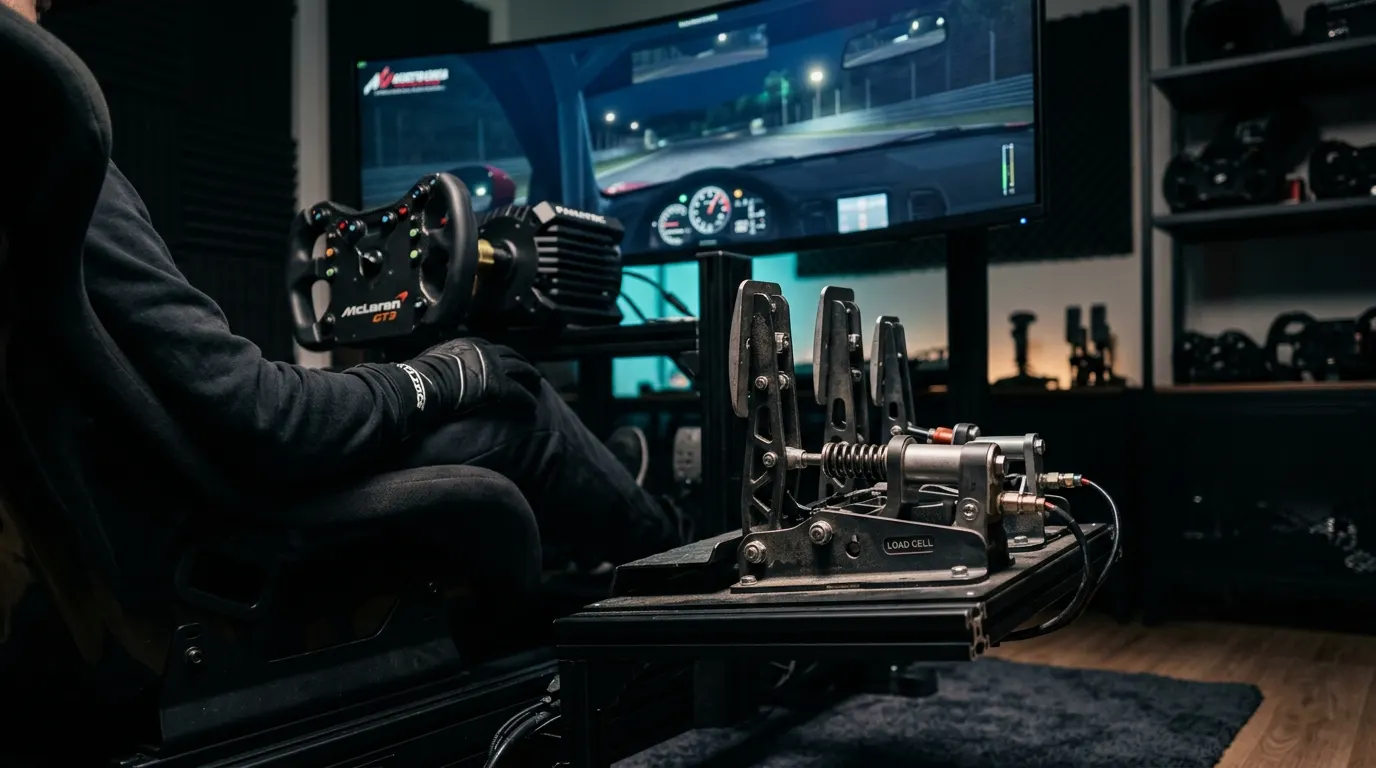
Pedals are the single hardware upgrade most likely to lower your lap times, and yet they are the piece of a sim racing setup drivers put off buying longest. The stock pedal set that ships with a Logitech G923 or an entry Thrustmaster bundle reads brake input as a distance measurement, and distance is a poor stand-in for the pressure-based braking every real car actually uses. Moving to a genuine load cell brake is what closes that gap. The Heusinkveld Sprint is the pedal set the sim racing community keeps coming back to, an all-aluminium three-pedal set with a wide spring rate range and reliability proven across thousands of hours of competitive use. If your budget is tighter, the Moza CRP2 brings a genuine 100 kg load cell brake in under $410 without cutting corners on construction, and the Sim-Lab XP1 at $299 to $349 goes lower still for aluminium profile rig builders. This guide ranks the best sim racing pedals across budget levels and explains what actually separates a good set from a mediocre one.
Quick answer
The Heusinkveld Sprint is the best sim racing pedal set for 2026, with an all-aluminium build and a wide spring rate range. The Moza CRP2 has a 100 kg load cell brake under $410. The Fanatec ClubSport V3 adds ABS pulse feel, and the Heusinkveld Ultimate Plus is the most realistic hydraulic option.
This guide contains affiliate links. PitLaneLab may earn a commission at no cost to you.
What actually separates a good pedal set from a mediocre one
The biggest divide in sim racing pedals is load cell versus potentiometer. A potentiometer brake reads pedal travel and maps that distance to a braking value, which means your foot is being asked to repeat a distance under pressure, something feet are not naturally good at. A load cell brake reads force instead, and force is the input a real car actually responds to, and the input your foot is naturally good at repeating consistently.
The second differentiator is build material and spring rate range. Plastic-bodied pedal sets flex under hard braking, which changes the feel exactly when you need it to stay consistent. Aluminium-bodied sets like the Heusinkveld Sprint Pedals and Moza CRP2 Load Cell Pedal Set hold their geometry under load. A wide spring rate adjustment range matters because braking feel preference varies significantly between drivers and disciplines, and a pedal set that can only be tuned one way will eventually feel wrong for some of what you drive.
Connection type is the last practical consideration. Most load cell pedals connect over USB and work as an independent device with any wheel base ecosystem. Fanatec pedals like the Fanatec ClubSport Pedals V3 also offer an RJ12 connection to a Fanatec base for ABS vibration features that only activate on that direct connection.
Best sim racing pedals ranked
The Heusinkveld Sprint Pedals at $499 to $549 is the top pick for 2026. Its all-aluminium three-pedal construction and wide spring rate adjustment make it the pedal set most competitive sim racers settle on and never replace. USB and RJ12 connection options mean it works cleanly with any wheel base ecosystem, and the community track record behind it spans years without a credible challenger at its price.
The Moza CRP2 Load Cell Pedal Set at $350 to $410 brings genuine load cell braking from a known brand. It has a 100 kg load cell brake and aluminium construction, and it connects over USB to any base including Fanatec, Simucube, and Logitech-Thrustmaster.
The Fanatec ClubSport Pedals V3 at $359 to $399 is the pick for Fanatec ecosystem owners. Its brake vibration motor simulates the ABS pulse you feel through the pedal as a real car approaches lock-up, a feature unique to this set. It connects natively over RJ12 to any Fanatec base or independently over USB.
The Asetek Forte Load Cell Pedals at $450 to $530 is the pick for drivers who want a brake feel closer to hydraulic progression without the hydraulic price. Its progressive spring kit and all-metal build target a stiffer, more real-car-like resistance curve than the more linear feel of the Sprint.
The Sim-Lab XP1 Load Cell Pedals at $299 to $349 is the natural pick for a Sim-Lab or aluminium profile rig build, since its geometry adjustment and mounting pattern integrate directly with profile rig pedal plates without custom brackets.
The Heusinkveld Ultimate Plus Hydraulic Pedals at $749 to $849 is the top-end pick for drivers who want the most realistic pedal feel available at any price. Its hydraulic brake system with real fluid and a master cylinder is used by professional sim academies, though it is genuine overkill for most home setups.

Heusinkveld Sprint Pedals
Full aluminium three-pedal set with a genuine load cell brake, adjustable spring rate, and the build quality Heusinkveld is known for in professional training rigs.

Moza CRP2 Load Cell Pedal Set
Three-pedal load cell set from Moza with aluminium construction, a 100 kg load cell brake, and USB connection that works with any base ecosystem.
Fanatec ClubSport Pedals V3
Fanatec's flagship pedal set with a vibration motor on the brake for ABS pulse simulation and a tunable load cell brake axis.

Asetek Forte Load Cell Pedals
Scandinavian-designed hydraulic-feel load cell pedals with an adjustable progressive spring kit and clean, competition-focused build.
Sim-Lab XP1 Load Cell Pedals
Aluminium profile-based load cell pedal set with wide adjustability in geometry, spring rates, and pedal face angles, built for aluminium profile rig integration.
Heusinkveld Ultimate Plus Hydraulic Pedals
Hydraulic brake pedal system using actual brake fluid and a master cylinder for the most realistic pedal feel in consumer sim racing hardware.
Matching pedals to your rig and wheel base
All the pedal sets in this guide connect over USB as an independent HID device, so ecosystem compatibility is rarely a real concern regardless of whether you run a Moza R9, Fanatec CSL DD, or Simucube 2 Sport wheel base. What matters more is rig integration. Floor-mounted pedals need a rigid surface that will not slide under hard braking, which is one reason a dedicated cockpit like the Trak Racer TR8 Pro Cockpit Rig or Sim-Lab P1X Cockpit Rig is worth pairing with a serious pedal upgrade.
Pedal plate angle also affects feel over long sessions. The Sim-Lab XP1 Load Cell Pedals and Sim-Lab P1X Cockpit Rig rig share a 45-degree pedal plate design intended for natural foot position, while other pedal sets bolt to whatever plate angle your own rig provides. If you are building a rig and pedal set at the same time, checking that the two are designed to work together saves a bracket headache later.

Trak Racer TR8 Pro Cockpit Rig
Heavy aluminium profile rig supporting wheel bases up to Simucube 2 Pro torque levels, with full adjustment for seat position, pedal angle, and wheel height.
Sim-Lab P1X Cockpit Rig
Heavy aluminium profile cockpit with a 45-degree pedal plate angle, wide side pod mounts, and direct compatibility with Sim-Lab's own pedal and button box range.
How to choose the right pedal set for your budget
If you are still braking on a stock potentiometer set, the single highest-value move is any genuine load cell brake, and the Moza CRP2 Load Cell Pedal Set or the lower-priced Sim-Lab XP1 Load Cell Pedals both get you there without a large outlay. If you already know sim racing is a long-term hobby and want to buy once, the Heusinkveld Sprint Pedals is worth the jump straight away rather than upgrading twice.
Fanatec ecosystem owners weighing the ABS vibration feature on the Fanatec ClubSport Pedals V3 should try it before assuming it is essential; some drivers find the extra vibration information useful under braking, others find it distracting. Drivers using a simulator for real driver training rather than competitive racing are the clearest case for spending up to the Heusinkveld Ultimate Plus Hydraulic Pedals, since the hydraulic feel transfer is the entire point of that purchase.
Featured in this guide
Heusinkveld Sprint Pedals
Full aluminium three-pedal set with a genuine load cell brake, adjustable spring rate, and the build quality Heusinkveld is known for in professional training rigs.
Moza CRP2 Load Cell Pedal Set
Three-pedal load cell set from Moza with aluminium construction, a 100 kg load cell brake, and USB connection that works with any base ecosystem.
Fanatec ClubSport Pedals V3
Fanatec's flagship pedal set with a vibration motor on the brake for ABS pulse simulation and a tunable load cell brake axis.
Asetek Forte Load Cell Pedals
Scandinavian-designed hydraulic-feel load cell pedals with an adjustable progressive spring kit and clean, competition-focused build.
Sim-Lab XP1 Load Cell Pedals
Aluminium profile-based load cell pedal set with wide adjustability in geometry, spring rates, and pedal face angles, built for aluminium profile rig integration.
Heusinkveld Ultimate Plus Hydraulic Pedals
Hydraulic brake pedal system using actual brake fluid and a master cylinder for the most realistic pedal feel in consumer sim racing hardware.
Related comparisons
Related roundups
FAQ
Frequently asked questions
What is the best sim racing pedal set overall?+
The Heusinkveld Sprint is the best all-round sim racing pedal set. Its all-aluminium construction, wide brake spring rate adjustment, and USB and RJ12 connection options cover every wheel base ecosystem, and it has held the top community recommendation for years without a credible challenger at its price.
Are load cell pedals actually worth it over a stock set?+
Yes, and it is usually the most noticeable single upgrade a sim racer can make. A stock potentiometer pedal like the one bundled with a Logitech G923 or Thrustmaster T300RS measures how far you push, and small variations in foot position at the limit of braking produce inconsistent results. A load cell pedal measures how hard you push, which is the same input a real car's brake responds to, and most drivers feel a consistency improvement within one or two sessions.
What is the difference between the Heusinkveld Sprint and the Moza CRP2?+
Both use a genuine load cell brake, but the Sprint costs roughly $150 more than the CRP2 and delivers a wider spring rate adjustment range plus a slightly firmer, more precise brake feel that serious racers notice over long sessions. The CRP2 still uses a 100 kg load cell and aluminium construction rather than plastic, so it is not a compromise pedal, just a less adjustable one. Budget-focused drivers get most of the benefit; drivers chasing the last few tenths get the rest from the Sprint.
Do I need three pedals or is two enough?+
For most circuit racing in iRacing or ACC, two pedals (throttle and load cell brake) are completely sufficient, since automatic launches and paddle shifting remove the need for a clutch. A third clutch pedal matters if you drive an H-pattern gearbox or plan to add rally and drift titles with manual shifting. Most of the pedal sets in this guide are sold as three-pedal sets regardless, so the clutch is there if you decide you want it later.
Should I buy hydraulic pedals instead of load cell?+
Only if realism transfer to real-world driving matters to your use case. Hydraulic pedals like the Heusinkveld Ultimate Plus use actual brake fluid and a master cylinder, producing a feel that is close to indistinguishable from a real car, and are used by professional sim academies for that reason. For the vast majority of home sim racers, a top load cell set like the Heusinkveld Sprint delivers around 95 percent of that feel at roughly 60 percent of the cost.